Source: venere.com
By Marlene Heloise Oeffinger May 22 2014
Low voices murmur in the night, just audible over the gurgling of the Vienna Danube Canal. Bright colored lights mark the building and its entrance, reflecting brilliantly off the calm water. It gives the place an almost carnival-like atmosphere. But the low rumbling of techno beats and bass than can be felt more than heard, rumbling through ground, gives away my location. No quaint Viennese coffeehouse, but the well-known Vienna nightclub Flex.
For several years, back in the late 90s, the Flex had been my second living room where I danced and hung out almost every night until four in the morning, before moving to London in ’98. The club has been around since 1990 when it first took up residence in the Arndtstrasse in Meidling, a less than popular Viennese district. It was originally founded by a group of music enthusiasts as an underground club and punk hangout, but quickly gained popularity outside these circles. During the early nineties and the emerge of electronic music, Vienna became an epicentre for techno, house and drum ‘n’ bass. Throughout this time the city birthed many world-famous DJs, such as Kruder & Dorfmeister. And with the city’s change in music scene, the Flex’ scene changed alongside. Punks gave way to ravers, and tolerant neighbors to complaining residents. As a result, in 1995 the Flex moved on to bigger and better shores – an empty subway tunnel along the Danube Canal in Vienna’s inner city district. And it has been there ever since.
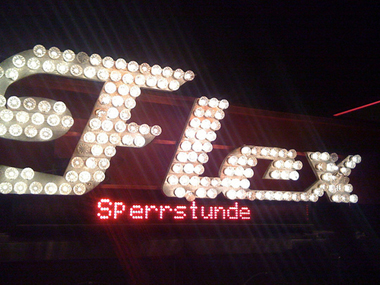
Looking across the banks of the canal in front of the club, everything seems the same, yet so different from when I last stood in the same spot sixteen years ago. Wooden picnic tables are still filled with people chatting, drinking beer, laughing. However their backdrop is not the unmarked red spray-painted door in a dirty concrete wall and pulled up metal shutters that once marked the Flex Café I knew, but rather a glitzy glass and chrome annex with the club’s name spelled out in neon letters above it. An outward sign of the club’s ascend from tolerated underground scene to accepted mainstream nightspot. Inside everything looks mostly the same; psychedelic light shows projected on rough concrete walls, a DJ hunched over turntables on the front stage, and people crowding the bar, vying for the barkeeper’s attention.
At first it looks no different than it did all those years ago. Until I look more closely at the people surrounding me. Gone are the girls in black short jumpsuits, stripy tights and braids, the guys with wife-beater shirts and long wrap-around skirts or low-hanging pants – the raver crowd. And the guys that you wouldn’t have wanted to meet in a dark alley. Instead, tonight I’m surrounded by a well-off college crowd that wants to live on the edge for one night – or maybe a few. It is interspersed with wide-eyed tourists, bobbing along to the beat. It is all too clear: the Flex has achieved mainstream status, to the point where it has become a tourist attraction, mentioned in guidebooks and on tourism websites.
In many respects the Flex is a mirror image of the city around it. Once a roughly hewn gem with pastel-colored palaces, Lipizaner horses and Mozartkugeln for most of the second half of the 20th century, Vienna has also changed its image over the past decade. It’s become greener, friendlier, more approachable. It’s marketing its current culture, rather than that of centuries gone by, and commercialized its underground scene along the way. But make no mistake, beneath it all, the dark edge of the city portrayed in movies like ‘The Third Man’ will always remain. In dark alleys, cobbled streets, withered statues and deserted city squares. Nowadays, these are just part of drawing the crowds, to make the city’s slogan ‘Vienna is different’ reality. And the same is true for the Flex. Underneath all the shiny façade and clean toilets, an edginess still remains. The walk down the dimly lit stairwell to reach the club, the setting within a disused subway tunnel, and the memories of nights past engrained within its walls, all make up its character, the authenticity people from all corners of life flock to. And I’ll join them for one night, reminiscing.
 Marlene Heloise Oeffinger