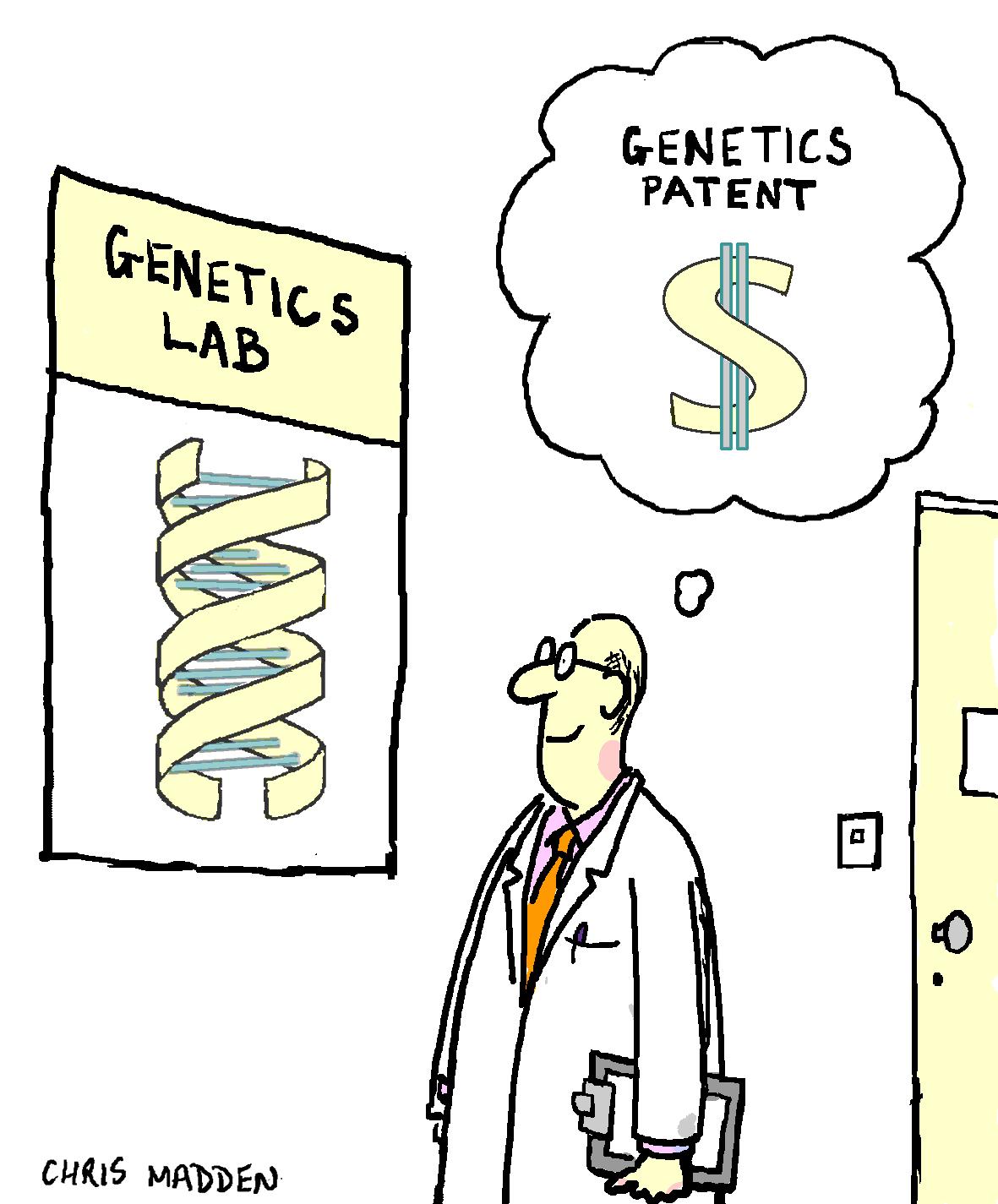
Source: darkdaily.com
By Marlene Heloise Oeffinger April 22 2013
Can genes be patented? That was the question posed to both the U.S. Supreme Court and Australian Federal Court earlier this month. And the answer should be – no.
The widely publicized case Association for Molecular Pathology vs. Myriad Genetics challenges the validity of gene patents in the United States, and has made many people listen up, even non-scientists. Not only because the two genes in question, BRCA1 and BRCA2, are the main markers in predictive testing for ovarian and breast cancer, which Myriad currently holds the monopoly for, but also because the outcome will most likely set a precedence for future handling of gene patenting, and maybe even past ones.
But while ethical issues about the commercialization of the human genome have been discussed at length in the media, one question has not been addressed – what are the consequences of gene patenting for academic research? Companies’ interests lie in the realm of finding new drugs and therapeutics for profit. It is academic, nonprofit research, however, that drives our knowledge about the underlying mechanisms of genes in disease development. Knowledge that is then used by companies to develop drugs and treatments.
Most, if not all, progress in science, in the past and now, occurs largely due to scientific discoveries being shared amongst researchers, a principle that applies in particularly to those working in universities, nonprofits, and other academic settings. The faster new knowledge is disseminated, the more rapidly research moves forward. An entire system of scientific journals was created just for this purpose. Research that remains secret cannot contribute to scientific progress and is, for all intents, worthless. Patenting genes will prevent scientific findings being shared with other scientists as companies do not publish or disseminate their research due to their worry of being outcompeted.
Moreover, should an academic scientist want to work on a patented gene, it involves endless hours talking with lawyers, negotiating licenses, and paying for such licenses to avoid law suits. Therefore most simply avoid patented genes entirely, preferring instead to work on others. The arising lost opportunities for new research cannot be measured but it is highly significant. Some people may question whether companies such as Myriad really would prosecute nonprofit scientists? The answer is – yes, they do. According to lawyers at the New York University School of Law, specializing in intellectual property law and science, Myriad has already sent researchers cease-and-desist orders regarding their work on the BRCA genes.
It demonstrates that patents and science stand in direct opposition and that patenting genes will severely undermine scientific process, including those on disease prevention and treatments. In fact it has already started. Originally, the system of property rights was established in the 17th century to acknowledge mechanical inventions, while providing inventors with protection against competitors and the ability to profit from their inventions. Genes are not inventions. Unless you want to grant a patent to Mother Nature.
Some argue that the BRAC genes patented by Myriad are variants of the original gene sequence that have been engineered in the laboratory and thus are not ‘natural’. However, this argument is flawed. These variants are of such great interest to companies and academic research alike because they are key in some breast and ovarian cancers – which occur in ‘nature’. Others state that the process of isolating the BRCA genes from the human body required human intervention. Thus, the isolated gene sequences represent an invention and are patentable. But this isolated sequence is still the same one that is found in human cells and therefore still no invention.
We also have to keep in mind that as publicized as this case may be, Myriad is not the only organization that holds these kinds of patents. Since the early 1980s the U.S. Patent and Trademark Office has issued thousands of patents for the exclusive genetic testing for a host of genes, many of them human including those related to cystic fibrosis and heart arrhythmias, and even entire cellular pathways. And yes, I understand that companies have to make profit and protect their assets, but research has and should be foremost about understanding the biology of our body, and, nowadays, its underlying genetic programs. If patents like the one held by Myriad Genetics are being granted or upheld, this will become a much more difficult task, ultimately impeding our understanding of preventing and treating disease. And so the question remains: whose gene is it? And the answer should be ‘no one’s’ – or ‘everyone’s’.
 Marlene Heloise Oeffinger
Pingback: Marlene Heloise Oeffinger